
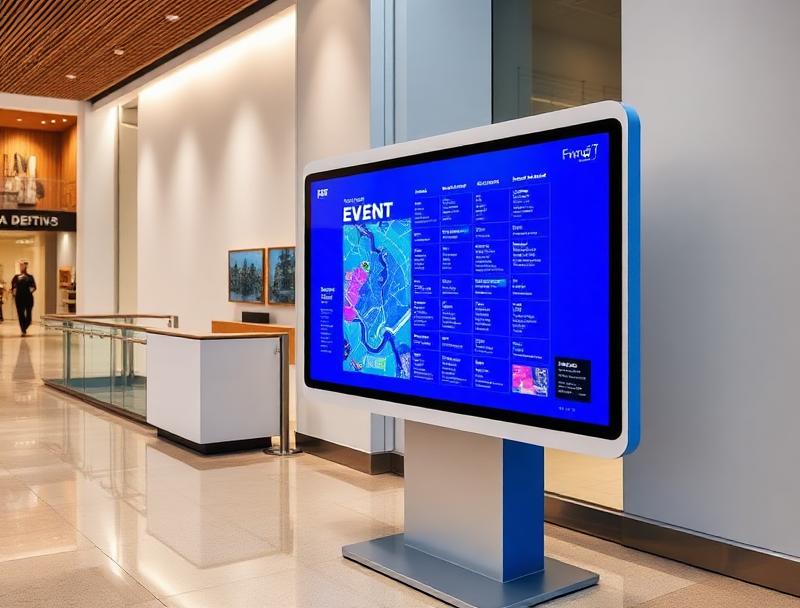
The kiosk is running, yet some visitors cannot reach the controls, distinguish the text or complete the process without help. Accessibility must be decided before selecting the enclosure and designing the interface, not checked after installation.
An accessible event kiosk combines location, hardware, software, content and assistance. Lowering a screen is not enough: people need to understand, operate and leave the complete journey without becoming stuck.
1. Define tasks and users before equipment
List what visitors will do: buy, check in, consult a map, print or request help. Review each task for people with different mobility, vision, hearing, dexterity or comprehension needs, including those using the kiosk with a companion.
Send the use case, event, city and venue via WhatsApp or email and we will assess a tailored setup.
2. Plan reach, approach and location
Front and side space to approach and turn
Screen, scanner, payment and printer within usable reach
Controls visible while standing or seated
A route without cables, bases or queues blocking access
Lighting and glare checked at the actual location
Measurements and requirements must be confirmed for the selected equipment, venue and applicable rules.
3. Avoid relying on one ability
Use readable text, sufficient contrast, large touch targets, direct instructions, adjustable time and error messages that explain how to continue. Do not rely on colour, sound or precise gestures alone. Test every required keyboard, scanner, payment or signature peripheral too.
4. Provide equivalent alternatives
| Barrier | Design decision | Operational alternative |
|---|---|---|
| Control out of reach | Adapted height and position | Equivalent assisted point |
| Text hard to read | Size, contrast and zoom | Human help or another channel |
| Audio required | Equivalent visual information | Accessible assistance |
| Not enough time | Extension without losing data | Assisted continuation |
An alternative should not send someone to another entrance or provide an inferior service.
5. Test the complete journey
Test with diverse users and final hardware: approach, start, read, scan, pay, correct, print, collect and leave. Include long names, languages, errors, missing paper and connectivity loss. A technical checklist does not replace real-use testing.
6. Prepare help and privacy
Make the way to request help perceptible and train staff to assist without taking control unnecessarily. Prevent personal data, codes and payments from remaining visible; allow time to collect documents and clear the session on completion or abandonment.
7. How Woolando can help
Woolando sells, rents and supplies kiosks and delivers complete projects throughout Spain. We can tailor equipment, interface, peripherals, ticketing, accreditation and integrations, with on-site support when required. Scope is defined after reviewing users, tasks, venue and applicable requirements.
Send the flow, dates, location and existing systems via WhatsApp or email info@woolando.es.